Black White Daisy Flower Border Art: A Practical Evaluation
In the realm of digital design assets, few motifs offer the enduring versatility of the daisy. When rendered in a strict black and white palette with a crisp outline style, this floral element transforms from a simple garden flower into a sophisticated structural component for visual communication. Black White Daisy Flower Border Art represents a specific category of decorative framing resources designed to add elegance without overwhelming the primary content. For professionals ranging from graphic designers to educators, these assets serve as a critical tool for organizing information, enhancing document aesthetics, and creating cohesive brand materials.
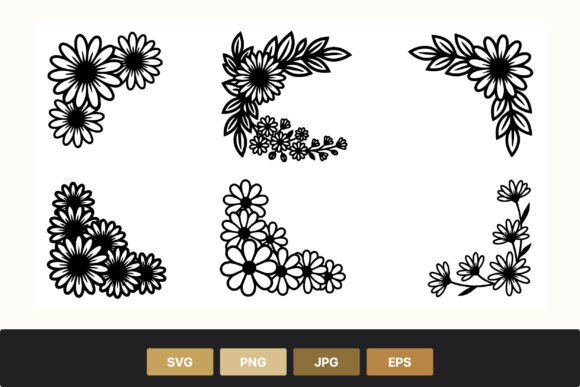
The value of such an asset lies not merely in its visual appeal but in its technical execution and adaptability. A well-constructed set of corner borders featuring detailed petals, leaves, and stems allows for precise control over layout hierarchy. Unlike busy, colorful illustrations that can distract from text or data, monochromatic line art provides a subtle boundary that guides the eye while maintaining readability. This article examines the practical utility, technical specifications, and real-world applications of Black White Daisy Flower Border Art to help you determine if it fits your creative workflow.
Defining the Aesthetic and Functional Role
At its core, Black White Daisy Flower Border Art is a collection of vector-based or high-resolution raster graphics intended for framing purposes. The "border" aspect implies a design meant to occupy the periphery of a page, card, or digital canvas, leaving the central area open for content. The inclusion of detailed petals and stems suggests a level of intricacy that rewards close inspection, while the black and white color scheme ensures compatibility with any background color or photographic element.
The crisp outline style is particularly significant in professional contexts. It mimics the look of traditional engraving or botanical illustration, lending an air of authority and timelessness to documents. This aesthetic is distinct from watercolor washes or solid shapes; it relies on negative space and line weight to define form. When used as corner borders, these elements anchor a design, preventing it from feeling flat or unstructured. They act as visual punctuation marks, signaling to the reader that the enclosed content is curated and important.
Technical Specifications and File Flexibility
The true utility of Black White Daisy Flower Border Art is often determined by the file formats provided in the download package. A robust resource bundle typically includes SVG, PNG, EPS, and JPG files, each serving a distinct purpose in a production workflow. Understanding these formats is essential for maximizing the asset's potential.
- SVG (Scalable Vector Graphics): This format is indispensable for designers who require infinite scalability. Whether the border needs to be resized to fit a business card or expanded for a billboard, the SVG file maintains perfect edge definition without pixelation. It also allows for direct editing in software like Adobe Illustrator or Inkscape, enabling users to adjust stroke weights, modify petal shapes, or separate individual elements for custom arrangements.
- PNG (Portable Network Graphics): For web designers and social media managers, the PNG format with a transparent background is crucial. It allows the black outlines to sit cleanly over colored backgrounds, patterns, or photographs without the need for complex masking. This makes integration into website headers, email templates, or Instagram stories immediate and efficient.
- EPS (Encapsulated PostScript): This format remains the standard for professional print applications. If you are preparing files for offset printing or sending artwork to a commercial printer, the EPS version ensures that the vector data is preserved at the highest fidelity, guaranteeing sharp results even at large scales.
- JPG (Joint Photographic Experts Group): While less flexible than vector formats, the JPG version offers universal compatibility. It is useful for quick previews, embedding in documents where editing is not required, or sharing with clients who may not have access to specialized design software.
This multi-format approach ensures that Black White Daisy Flower Border Art can be utilized across a wide range of creative and production workflows, from rapid digital prototyping to high-end print finishing.
Design Consistency and Visual Hierarchy
One of the strengths of a coordinated set of corner borders is consistency. When designing a series of documents—such as a wedding invitation suite, a corporate annual report, or a classroom workbook—using matching elements creates a unified brand identity. The detailed petals and leaves found in this specific art style provide enough texture to prevent the design from looking sterile, yet they remain disciplined enough to avoid clutter.
From a usability perspective, these borders excel at establishing visual hierarchy. By placing the Black White Daisy Flower Border Art in the corners of a page, you naturally draw attention to the center. This is particularly effective for certificates, diplomas, or menus where the central text must be the focal point. The organic nature of the flowers softens the rigid geometry of a page layout, making the overall composition feel more inviting and human-centric.
Real-World Applications and Use Cases
The applicability of Black White Daisy Flower Border Art extends far beyond simple decoration. Professionals in various sectors find practical value in these assets for specific project types.
Stationery and Print Design: Entrepreneurs and small business owners often use these borders for letterheads, invoices, and business cards. The monochromatic style ensures that the design prints clearly even on lower-quality paper or with limited ink coverage. The elegant lines convey professionalism without the cost of full-color printing.
Digital Content Creation: Bloggers and marketers frequently incorporate these elements into featured images, blog post headers, and social media graphics. The transparent PNG versions allow for seamless overlay on lifestyle photography, adding a touch of sophistication to product showcases or quote graphics.
Education and Publishing: Educators and publishers utilize these borders to frame worksheets, reading comprehension exercises, and children's book pages. The friendly yet structured appearance of the daisy motif appeals to younger audiences while providing clear boundaries for writing activities.
Event Planning: For weddings and formal events, these borders are ideal for invitations, programs, and table cards. The classic black and white aesthetic aligns perfectly with vintage, rustic, or modern minimalist themes, offering a versatile backdrop for event details.
Quality Assessment and Limitations
When evaluating Black White Daisy Flower Border Art, it is important to consider both its strengths and its limitations. The primary strength is the balance between detail and simplicity. The detailed petals and stems add character, but the lack of color keeps the focus on the line work. However, this reliance on line weight means that the quality of the original vector paths is paramount. If the strokes are too thin, they may disappear when scaled down for mobile screens or printed on textured paper. Conversely, if they are too thick, they can dominate the layout.
Another consideration is the stylistic fit. While the daisy motif is generally universally appealing, it carries connotations of innocence, spring, and simplicity. It may not be appropriate for industries requiring a stark, industrial, or highly aggressive aesthetic. For example, a heavy machinery catalog or a cybersecurity firm might find this floral imagery incongruous with their brand voice. Users should evaluate whether the organic nature of the flower aligns with their specific message.
Furthermore, while the ZIP file format offers convenience, it requires the user to have the necessary software to extract and utilize the different file types effectively. Users relying solely on basic image viewers will miss out on the editing capabilities of the SVG and EPS files. Therefore, the asset is best suited for individuals or teams with at least a foundational understanding of design tools.
Strategic Recommendations for Implementation
To maximize the value of Black White Daisy Flower Border Art, consider the following strategic approaches:
- Maintain Proportions: When scaling the borders, ensure that the relationship between the petals, leaves, and stems remains consistent. Distorting the aspect ratio can ruin the delicate balance of the outline style.
- Use Negative Space: Do not overcrowd the page. These borders are most effective when there is ample white space around them, allowing the intricate details to breathe.
- Customize Stroke Weight: If using the SVG or EPS files, experiment with adjusting the stroke weight to match the weight of your typography. Matching the line thickness of the border to the font weight of your headers creates a harmonious visual rhythm.
- Test Across Media: Before finalizing a design, preview the asset in both digital and print environments. Check how the black outlines render on different screen brightness levels and paper textures.
In conclusion, Black White Daisy Flower Border Art offers a reliable, versatile, and aesthetically pleasing solution for framing and decorating a wide variety of projects. Its combination of detailed botanical elements and a timeless monochromatic palette makes it a valuable addition to any designer's toolkit. By leveraging the multiple file formats provided, users can adapt these assets to meet the demands of both digital and print production. While it requires thoughtful application to ensure stylistic alignment, the long-term value and flexibility of this resource make it a worthwhile investment for professionals seeking to elevate their visual communications.