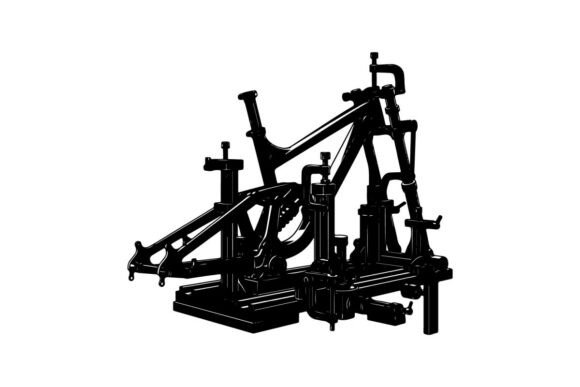
Detailed Industrial Machine Mechanism in Premium Vector Silhouette Clip Art
In the realm of professional design, the ability to convey complex functionality through simple visual language is a distinct competitive advantage. The Detailed Industrial Machine Mechanism in premium vector silhouette clip art represents more than just an illustration; it is a strategic asset for brands and creators aiming to communicate precision, reliability, and innovation. When integrated thoughtfully into a visual identity or marketing campaign, this specific type of artwork bridges the gap between technical complexity and accessible design, allowing audiences to instantly grasp the essence of industrial capability without getting lost in unnecessary detail.
For entrepreneurs, marketers, and small business owners operating in sectors ranging from manufacturing and logistics to tech startups and educational platforms, the choice of imagery dictates the perceived quality of the brand. A Detailed Industrial Machine Mechanism rendered in a clean, modern silhouette style offers a polished aesthetic that aligns with contemporary design trends while maintaining timeless relevance. This article explores how leveraging such high-quality assets can support strategic goals, enhance operational communication, and drive better long-term results.
The Strategic Value of Simplified Complexity
At its core, the Detailed Industrial Machine Mechanism serves as a visual shorthand. In an era where attention spans are short and information density is high, clarity is king. A full-color, photorealistic rendering of a machine often requires significant cognitive load to process. Conversely, a silhouette strips away texture, color, and extraneous data, leaving only the essential form. This reduction allows the viewer to focus on the function and structure of the mechanism itself.
Strategically, this simplification supports several key objectives:
- Brand Positioning: It signals that a company values efficiency and streamlined operations. The clean lines suggest a no-nonsense approach to problem-solving.
- Visual Consistency: Silhouettes are easier to integrate into diverse layouts, from mobile app icons to large-format trade show banners, ensuring the brand looks cohesive across all touchpoints.
- Universal Appeal: By removing specific textures or dated color palettes, the Detailed Industrial Machine Mechanism remains relevant regardless of shifting design fads, protecting the longevity of your visual assets.
When you choose a Detailed Industrial Machine Mechanism in this format, you are making a decision to prioritize communication over decoration. This is particularly useful for B2B companies where trust and competence are the primary currencies. A client scanning a proposal or website will subconsciously associate the crisp, professional look of the vector art with the reliability of the services offered.
Enhancing Communication and Operational Clarity
Effective communication extends beyond marketing copy; it encompasses every visual interaction a customer has with a business. Whether you are creating instructional manuals, safety posters, or digital presentations, the use of a Detailed Industrial Machine Mechanism can significantly improve comprehension. The balanced shapes and clear outlines inherent in high-quality silhouette clip art ensure that even intricate mechanical parts are distinguishable at various sizes.
Consider the application in educational content or training materials. Educators and trainers often struggle to find visuals that are detailed enough to be accurate but simple enough to be understood quickly. A vector-based silhouette solves this dilemma. Because the artwork is built with optimized vector paths, it maintains crisp edges when scaled up for a classroom projector or shrunk down for a handout. This scalability ensures that the message remains clear regardless of the medium.
Furthermore, in the context of branding and operations, these assets facilitate faster production cycles. Designers do not need to spend hours photographing equipment or retouching complex images. Instead, they can utilize a library of Detailed Industrial Machine Mechanism silhouettes to rapidly prototype concepts, test layouts, and finalize designs. This efficiency translates directly into productivity, allowing teams to focus their energy on strategy and execution rather than asset creation.
Practical Applications Across Industries
The versatility of the Detailed Industrial Machine Mechanism makes it applicable across a wide spectrum of industries. Here are practical examples of how different professionals can leverage this resource:
- Manufacturing and Engineering: Use these silhouettes in annual reports, white papers, and product brochures to illustrate capabilities without revealing proprietary trade secrets. The abstract nature of the silhouette protects intellectual property while still conveying industrial strength.
- E-commerce and Merchandise: For creators selling custom merchandise, the clean outlines of the vector art ensure smooth cutting on vinyl cutters and laser engravers. This precision leads to higher quality physical products, reducing waste and returns.
- Web and Digital Content: Bloggers and publishers can use these graphics as section dividers, iconography, or background elements. The modern aesthetic enhances the user experience by breaking up text-heavy pages with visually appealing, thematic imagery.
- Freelancers and Agencies: Offering clients a suite of consistent, high-quality industrial graphics can differentiate a freelancer's portfolio. It demonstrates an understanding of industry-specific needs and an ability to deliver polished, ready-to-use solutions.
Decision-Making: When and How to Implement
While the benefits are clear, the successful integration of a Detailed Industrial Machine Mechanism requires intentionality. It should not be used randomly to fill empty space. Instead, its deployment must align with specific strategic goals. Before incorporating this asset into a project, consider the following planning tips:
- Define the Objective: Are you trying to explain a process, evoke a feeling of robustness, or simply add visual interest? If the goal is to show a specific model of machinery, a silhouette may be too abstract. However, if the goal is to represent "industrial power" generally, it is ideal.
- Assess the Audience: Does your target demographic respond better to technical diagrams or stylized art? For general consumers, the silhouette is often more engaging. For highly technical engineers, it may serve best as a supporting graphic alongside detailed schematics.
- Check Compatibility: Ensure the vector file is compatible with your workflow. Since the Detailed Industrial Machine Mechanism is designed with optimized paths, it should perform reliably in Adobe Illustrator, CorelDRAW, and various cutting machine software. Verify the file format before committing to a large-scale project.
- Maintain Brand Alignment: While the silhouette is versatile, it must fit within your existing color palette and typography. The strength of the black-and-white outline lies in its ability to adapt, but it should never clash with the surrounding design elements.
Approaching the implementation with a clear plan ensures that the asset adds value rather than clutter. It transforms a generic image into a purposeful component of your broader communication strategy.
Risks of Contextless Usage
Despite its flexibility, there are risks associated with using a Detailed Industrial Machine Mechanism without clear context. One common pitfall is the "generic trap." If the imagery does not resonate with the specific narrative of your brand, it can appear disjointed or impersonal. For instance, using a heavy industrial gear silhouette for a delicate software startup might send mixed signals about the company's nature.
Additionally, relying solely on stock silhouettes without customization can lead to a lack of differentiation. Many competitors may have access to similar libraries. To mitigate this, designers should manipulate the vectors—combining multiple mechanisms, altering scales, or integrating them with custom typography—to create a unique visual signature. The goal is to use the Detailed Industrial Machine Mechanism as a foundation for creativity, not as a final product that requires no further thought.
Another risk involves oversimplification. While silhouettes excel at conveying general concepts, they may fail to communicate critical nuances required for safety instructions or precise technical specifications. In such cases, the silhouette should be supplemented with detailed annotations or paired with more granular imagery to avoid ambiguity.
Long-Term Value and Future-Proofing
Investing in high-quality vector assets like the Detailed Industrial Machine Mechanism is a forward-thinking decision. Unlike raster images, which degrade when enlarged, vector graphics offer infinite scalability. This means that a design created today for a social media post can be seamlessly adapted tomorrow for a billboard or a building wrap without any loss in resolution.
This longevity provides significant cost savings over time. Businesses do not need to commission new photography or illustrations every time their output requirements change size. Furthermore, the timeless aesthetic of the silhouette style ensures that the brand identity does not become outdated as design trends shift. By focusing on fundamental shapes and balanced compositions, the Detailed Industrial Machine Mechanism remains effective years after its initial creation.
Ultimately, the strategic use of this clip art empowers decision-makers to build resilient, adaptable, and professional visual systems. It supports the broader mission of achieving clarity, efficiency, and impact in a crowded marketplace. By understanding the mechanics of visual communication and selecting tools that align with those principles, professionals can elevate their projects from merely functional to truly exceptional.