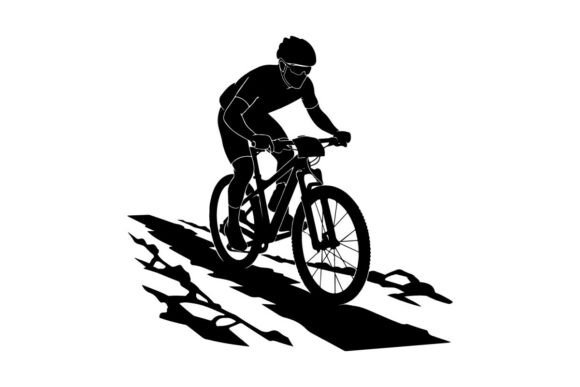
Evaluating the Cyclist Resting on Mountain Bike Silhouette for Your Design Projects
In the realm of graphic design, particularly when sourcing assets for branding, merchandise, or digital content, the choice between detailed illustration and minimalist abstraction often defines the success of a visual campaign. The Cyclist Resting on Mountain Bike with Sc represents a specific category of premium vector silhouette clip art that prioritizes clean outlines, balanced shapes, and a modern aesthetic. Unlike hyper-realistic renderings or complex line drawings, this asset is engineered to offer simplicity without sacrificing visual impact. For designers, marketers, and creative professionals aged 20 to 50 who are navigating the vast landscape of stock imagery, understanding the distinct utility of this specific silhouette style is crucial for making informed resource decisions.
Defining the Aesthetic: What Makes This Silhouette Distinct
The Cyclist Resting on Mountain Bike with Sc is not merely an image of a person on a bicycle; it is a study in negative space and form. The "SC" designation typically refers to a specific stylistic cut or a collection identifier within a premium library, denoting a focus on streamlined vector paths. What sets this particular asset apart from generic clip art is its structural integrity. The design eliminates unnecessary internal details—such as facial features, fabric textures, or mechanical component specifics—to focus entirely on the posture and the relationship between the rider and the machine.
This approach creates a timeless aesthetic. While trends in illustration fluctuate between flat design, isometric views, and 3D rendering, the silhouette remains a constant in effective communication. The resting pose captured in this artwork suggests a moment of pause, recovery, or contemplation, which adds a narrative layer often missing from action-oriented cycling graphics. By removing distracting elements, the Cyclist Resting on Mountain Bike with Sc allows the viewer to project their own context onto the image, whether that context is endurance sports, outdoor lifestyle, or mental resilience.
Comparative Analysis: Silhouettes vs. Detailed Illustrations
When evaluating resources for a project, it is essential to compare the silhouette format against other common alternatives such as detailed vector illustrations, photographic overlays, and hand-drawn sketches. Each format serves a different purpose, and the decision often hinges on the intended application and the complexity of the final layout.
Detailed Vector Illustrations provide depth, color variation, and texture. They are ideal for editorial covers or standalone posters where the image must carry the entire weight of the visual message. However, they can be visually heavy and may clash with intricate backgrounds or dense typography. In contrast, the Cyclist Resting on Mountain Bike with Sc offers a "clean and polished design structure" that integrates seamlessly into busy compositions. Its lack of internal detail ensures legibility even at smaller sizes, a significant advantage for iconography or small-format prints.
Photographic Elements bring realism but often suffer from lighting inconsistencies when placed on colored backgrounds or combined with other graphic elements. A photograph requires careful masking and color grading to look cohesive. The silhouette, being a solid shape, avoids these pitfalls entirely. It acts as a neutral anchor that can be colored to match any brand palette instantly. Furthermore, while photos are limited by their original resolution, the high-quality vector structure of the cyclist silhouette ensures crisp edges at any scale, from a business card to a billboard.
Hand-Drawn Sketches offer a human, organic feel but can introduce a level of inconsistency that some corporate or modern brands wish to avoid. The geometric precision of the Cyclist Resting on Mountain Bike with Sc provides a professional, uniform look that aligns well with contemporary design standards focused on minimalism and clarity.
Technical Advantages: Scalability and Workflow Efficiency
For professionals utilizing cutting machines like Cricut or Silhouette Cameo, or those working in industry-standard software such as Adobe Illustrator or CorelDRAW, the technical specifications of the asset are just as important as its visual appeal. The Cyclist Resting on Mountain Bike with Sc is built with optimized vector paths, which translates directly to workflow efficiency.
One of the primary tradeoffs in using lower-quality clip art is the presence of stray points, overlapping nodes, or broken paths that require hours of cleanup before use. This premium silhouette is crafted to eliminate those friction points. The streamlined design ensures smooth cutting for vinyl applications and precise editing for digital manipulation. Whether you need to expand the bike's frame slightly to fit a logo or adjust the rider's posture to match a specific composition, the vector data supports these modifications without degrading the file quality.
This scalability is a critical factor for businesses producing custom merchandise. A designer might need the same image for a small water bottle label and a large event banner. With raster images or poorly constructed vectors, upscaling results in pixelation or jagged edges. The Cyclist Resting on Mountain Bike with Sc maintains its sharpness regardless of size, ensuring that the professional quality of the output remains consistent across all mediums.
Key Technical Benefits
- Fully Scalable: Infinite resizing without loss of resolution.
- Clean Paths: Optimized for cutting machines and laser engraving.
- Software Compatibility: Works seamlessly across major design platforms.
- Editability: Easy color changes and minor structural adjustments.
Best-Fit Situations and Strategic Application
Understanding when to deploy the Cyclist Resting on Mountain Bike with Sc is key to maximizing its value. This asset is particularly well-suited for projects that require a strong, recognizable icon rather than a focal point of artistic expression. It excels in scenarios where the message needs to be conveyed quickly and clearly.
Branding and Logos: For cycling clubs, outdoor gear companies, or wellness retreats, this silhouette can serve as a foundational element for a logo. Its simplicity allows it to remain memorable and reproducible across various touchpoints, from app icons to embroidered patches.
Merchandise Design: T-shirts, stickers, and mugs often benefit from bold, single-color graphics. The silhouette's clean lines translate perfectly to screen printing and heat transfer processes, reducing production costs and minimizing registration errors that occur with multi-layered designs.
Digital Content and UI: In web design or mobile applications, where load times and clarity are paramount, a lightweight vector silhouette is superior to heavy image files. It loads instantly and scales responsively across different device screens.
Limitations and When to Choose Alternatives
While the Cyclist Resting on Mountain Bike with Sc offers numerous advantages, it is not a universal solution. There are specific contexts where its limitations become apparent, necessitating a different approach.
If a project demands emotional nuance through facial expressions or specific environmental storytelling—such as showing the rugged terrain of a mountain trail in detail—a silhouette may fall short. The abstraction inherent in this style removes the texture of the environment and the emotion of the face. In such cases, a detailed illustration or a high-resolution photograph would be more appropriate to convey the grit and atmosphere of the experience.
Additionally, if the target audience expects a highly stylized, retro, or cartoonish aesthetic, the modern, clean lines of this silhouette might feel too sterile. Designers aiming for a vintage poster look or a playful, hand-crafted vibe should explore alternative styles that incorporate grain, brush strokes, or exaggerated proportions.
Finally, consider the color strategy. While silhouettes are easily recolored, they rely heavily on the background for contrast. If a design concept involves a complex, multi-colored background with low contrast areas, a solid black or white silhouette might get lost. In these instances, a version with internal detailing or a gradient fill might be required to ensure visibility.
Making the Decision: Factors for Evaluation
When deciding whether to integrate the Cyclist Resting on Mountain Bike with Sc into your creative toolkit, weigh the following factors against your project goals:
- Clarity vs. Detail: Does your message require immediate recognition (silhouette) or deep engagement (detailed art)?
- Production Method: Are you cutting vinyl, screen printing, or creating digital assets? Vector silhouettes excel in physical production.
- Brand Consistency: Does the minimalist style align with your existing visual identity?
- Scalability Needs: Will the asset need to appear in vastly different sizes? If yes, the vector format is essential.
Ultimately, the Cyclist Resting on Mountain Bike with Sc is a powerful tool for designers seeking versatility and professional polish. It bridges the gap between functional iconography and expressive art, offering a reliable foundation for a wide array of creative journeys. By understanding its strengths and recognizing its limitations, you can confidently select the right resource to elevate your next project, ensuring that your visual communication is as effective and enduring as the journey itself.